Wednesday, May 24, 2017

Canal Conversations

Have you stopped by the museum recently? We’re nearing the end of our opening month and the museum’s been busy lately!!

The museum has a few new things for visitors to explore on their visit. The Waterford Historical Museum and Cultural Center is joining the statewide events to celebrate the beginning of the Erie Canal Bicentennial with our new exhibit, “Always Know Your Pal”.


Join us as the lyrics of the iconic “Erie Canal Song” guide you through canal history and culture in a fun and musical way. See how well you remember that song from when you last had it stuck in your head – you’ll be sure to be humming along with our exhibit!


Kids can check out our activity booklet and our coloring areas too! We definitely would love to have some of that artwork up on the walls for visitors to enjoy:)


And don’t forget to sign our “Canal Conversations” community exhibit. We’re encouraging visitors to be more involved in the exhibit by sharing their own stories!

Fill out a post-it note with a story of what makes the canal memorable to you -  was it growing up alongside the canal, hearing family tales about life on the canal, maybe trips you’ve taken on the canal or visits to events like Tugboat Roundup or through a school trip like the museum’s Canalways program! What has you interested in the canal? And if you’re not up for storytelling (you can be anonymous with your story too) you can leave your mark just by signing your name to one of the star notes and putting it up on our board to be a part of the celebration!


Here’s a few quotes from some of the stories already on our wall:

“My first journey on the Erie Canal was during the summer of 1997…I remember most how serene the trip was, and the view of urban communities…”

“My JoJo would take me on a nearly daily walk to the ruins….It was like exploring the ruins of some ancient civilization or that I was Indiana Jones scaling that wall of the canal…”


“When I was in elementary school we did a school wide presentation on the Erie Canal. My grade did a song and dance routine to the song, “The Erie Canal Song”…”


Our Canalways school program was also a part of the celebrations this year too! The students were able to get some great hands-on experience with interacting with the history of the canal and Waterford. The lieutenant governor was there on Friday and students got to be a part of the big kick-off bicentennial event down at the harbor visitor center and Lock 2-E park area.


And guess which song they sang? If you can’t guess, you can always stop by the museum for a reminder…

Thursday, April 20, 2017

April/May Newsletter Extras


Here's a sample  - and extras - of some of the articles in the museum's newsletter that members can enjoy:

The Waterford Historical Museum’s collection includes items both historical and anthropological.  These items are examples of archaeological pieces of the Native American history of Waterford.


Items like these stone arrowheads
of varying styles are examples of
stone tools of native tribes
The Native American culture in Waterford that early settlers to the area came into contact with were the Mahican, an Algonquin-speaking tribe that had occupied the banks of the upper Hudson River, extending north almost to Lake Champlain. The Mahicans were bordered to the west by their Iroquois neighbors, the Mohawks, with whom they clashed periodically.  Like the waters, these tribes’ lands met at Waterford. As such, when Europeans made their way up to this area, both groups recognized potential allies as well as trading partners. The Dutch, wanting a sustainable trade environment, often were responsible for Mahican-Mohawk peace agreements.

The Mahican - one of the few tribes to side with the Americans during the Revolution and also acted as American negotiators with tribes in the west - became known as the Stockbridge tribe and sold their remaining lands in New York in 1822 to relocate to reservations in Wisconsin. The Mohawks were forced to give up their lands in New York following the Revolution, until the Treaty of Canandaiga in 1794 gave them rights to some land; today, the Mohawk live on reservations in southeastern Canada and northern New York.


Shawna's amazing photos
of our images include this piece -
read our newsletter to find out
what this quirky little item is!


The museum also wants to show off some of the great work our fantastic interns have been doing for us over the spring semester!

Thanks to Catherine Sharkey of SUNY Albany and to Shawna Fitzsimmons of Hudson Valley for making significant contributions to updating the museum's database records of its collection.

Become a member today to read more about the items featured in our "History Highlights"  and "From Our Interns" pieces!


Thursday, March 30, 2017

Paul Schneider Lecture

"This little jaunt turned out extremely agreeable..." was a very apt name for the Waterford Historical Museum and Cultural Center's final lecture to wrap up this year's winter lecture series.

After getting snowed out of our previous time slot, a great big thank you is in order for all those who made it to the lecture. We had a good crowd of interested learners and a spectacular lecture by Paul Schneider on early accounts of Waterford history.


Jumping into the diaries of these two Scottish immigrants required a bit of background to understand why these men came here and context for their observations. Luckily, Paul was able to do so with some great images to illustrate the history leading up to where these diaries begin.

The two men we followed through their daily entries were John Strachan who came to New York in 1819 and settled in Halfmoon in 1821 with his family on a plot of land that still has the buildings he had constructed on the property. The other, Alexander Stewart Scott, came to Halifax in 1815 and toured through Waterford as he sailed along the canals in 1826.

The burning of Buffalo by British forces during the War of 1812
in retaliation for the burning of York by American forces in 1813


Both men were Scottish immigrants who came with the wave of Scottish settlers -
~14% of Scotland's population - following the War of 1812. Most of the fighting for this war was in New York State and in Canada, namely along the Niagara Frontier and Lake Champlain. But the Napoleonic Wars also were ongoing for the British as they fought the French, with many looking for better economic opportunities by crossing the Atlantic.


The land in this area has always been desirable, as Paul spoke of with images of military roads that ran through here, early efforts at waterway management by the Western Inland Lock Company.

Travel books became popular with the construction of the canals, providing another reason for people to stop in Waterford for either business or sightseeing.


Strachan made a home for himself with a plot of land he'd managed to purchase, setting up a farm in which he planted several varieties of trees to make a profit.

A scan of one of Stachan's diary pages gives us a glimpse of his daily concerns, as he marks down plans for planting designs in addition to short-hand remarks about the weather and other small details.

Paul put together a great image using historical resources and Google maps to
plot out familiar points to help pinpoint the location of John Strachan's farm


Strachan made a note of some interesting events in Waterford - like the visit of General Lafayette when he made a tour of the United States in 1825, passing through Halfmoon and Waterford on July 1st of that year. He also had a humorous story regarding the misadventures of the Rensselaer and Saratoga Railroad that passed his lands-
A sketch of one of the first Rensselaer and Saratoga Railroad locomotive
The train with six cars and 300 passengers had an unscheduled delay when it crossed paths with a cow that had wandered onto the trains and damaged the locomotive, leaving Strachan very pleased with himself for not accepting the invitation to travel on one of the first trips the train made.


Some notable events that he didn't mention in his diary include the 50th Anniversary of the country, nor does he mention the passing of John Adams and Thomas Jefferson.


The route Scott would have journeyed along, with the red circles
marking stops along the way - including Waterford
Alexander Stewart Scott, however, did make a note of that event in his diary as he traveled along the canals. Paul mapped out the routes he had taken as he traveled through Waterford, making a remark on it being a neat little village and of a certain guest that his boat had picked up at this stop. General Van Schoonhoven travelled the canal with him for a brief time and seems to have been happy to give Alexander a tour of his own as they passed by landmarks like Bemis Heights as they passed through Saratoga.

He also noted what travel was like on the canal with his own humorous anecdote read to us by Paul. Packet boats were known for being a bit...cramped...when it came to sleeping conditions that passengers experienced if they stayed the night aboard one of these vessels. During one night, Alexander wrote of how he'd inadvertently smacked the man in the bed next to him with his hand. The sleepy man responded as though under attack, falling out of his bed and roughing up the nearest body next to him before coming to his senses, luckily without hurting anyone even though it had woken everyone on board the boat. Alexander wrote of how difficult it was for him to keep from laughing aloud and giving himself away as being at fault, especially whenever he saw the other man who'd managed to bruise his face with his abrupt fall from his sleeping cot.


As a law student, it was impossible for Scott not to make some comment on the law system he observed here, noting how Americans didn't seem to have the same decorum he was used to in British North America, with -to him -  improperly casual attire lacking the fine coats and wigs all lawmen wore. But, aside from the nitpicking of our courts, Paul read out one of his final remarks about his travels in America, which was a pleasant surprise to the Canadian. He'd come to New York expecting far worse apparently if his comment was how he found Americans not to be not that bad.

Thanks again to Paul for a fantastic lecture about his ongoing research concerning these individuals' stories, as well as the story around the journals too.

The Waterford Historical Museum and Cultural Center has photocopies of Strachan's journal and this research is a great help to supporting our endeavor toward preserving and teaching the past!

Thanks to everyone who came out to join us!


Monday, March 13, 2017

March Lecture Rescheduled


Winter is looking to get in one more (hopefully) memorable storm for this year before the start of spring.


With so much snow and cold temperatures anticipated, there is a concern for maintaining safety.


The museum will reschedule its final lecture scheduled for March 14th at the Van Schaick Island Country Club. Paul Schneider will present his lecture "This little jaunt turned out to be extremely agreeable..." Little Known Accounts of Waterford  for the 28th of the month.

Mr. Schneider will be presenting his research to us in a fascinating lecture about Waterford history, based on the writings of two Scottish immigrants. One, a young Canadian law student who travelled through Waterford on a journey through New York State in 1826 and recorded his experiences in a journal that is now in the collections of the New York State Library. the other, a middle-aged immigrant who came to the United States in 1819 and permanently settled in Halfmoon in 1821. his extensive diary, now in the collections of the Rensselaer County Historical Society, offers unique insights into early Waterford.

Please keep checking our website and Facebook page for more details about rescheduling. Stay safe and keep warm everyone!

Wednesday, March 8, 2017

International Women's Day - Waterford Women


Taking part in this year’s International Women’s Day, the Waterford Historical Museum and Cultural Center is highlighting a couple of women who made it onto the “Wall of Characters” during its celebration of the town's bicentennial.

Emma Willard  
Emma was a leading advocate for women’s education, with a wide-reaching influence that can still be found today. She began conducting a school for girls in 1814 in Vermont, devising a new method of teaching and introducing new studies.  She wrote A Plan for Improving Female Education to share her ideas on education, proposing a women’s seminary be publicly funded like men’s schools were funded. Waterford businessmen developed a plan for a women’s school and sent a copy of the letter to Gov. DeWitt Clinton, who extended the invitation to Mrs. Willard to come to New York State. On March 19, 1819, an Act by the State of New York incorporating the Waterford Female Seminary or Academy led to Emma Willard opening her first school in Waterford, NY. According to historian Col. Sydney Hammersley, the original location believed to first house her school was the Demarest building on Broad Street (The Morgan House), and then at 77 Second Street where it introduced the study of higher mathematics to women. The first graduate of this first Willard school was a Miss Cramer, later known as Mrs. Curtis. Due to the funds she had been promised not fully materializing, Emma Willard moved out of Waterford in 1821 to set up a school in Troy, NY. There were attempts to keep an established female seminary in this Waterford location after Emma Willard left. This system of establishing an “Academy” had become very popular, and Waterford’s Academy was among others that New York State recognized  as being the gateway to learned professions for those who couldn’t afford a collegiate education. She left the Troy Female Seminary in the hand of her son and daughter-in-law, remarrying in 1838 for nine months, and spent her later years traveling across America and Europe promoting women’s education. She died April 15, 1870 and is interred in Oakwood Cemetery in Troy, NY. Her Troy school was renamed in 1895 to honor her as the Emma Willard School. She was inducted into the Hall of Fame for Great American in 1905.

Maria Rynders

Maria – and her brother Captain Isaiah Rynders- was a notable figure in Waterford. While his political battle and tactics weren’t well-received by Waterfordians, Maria was a character who gained quite a reputation. For those who made it to the museum’s exhibit, you learned that she made it into Ripley’s Believe It Or Not for her actions that were strange enough to merit such a distinction. What actions were these? No, not sword-swallowing or tight-rope walking over the Cohoes Falls. Maria did the bizarre in choosing to wear slacks, marry  repeatedly (okay, frequently), and vote long before women’s suffrage. She also was the resident firewoman, attending the fires with the men and working “on the brakes” (the hand-pumped fire engine) during Waterford’s 1841 fire. She smoked a clay pipe and apparently had some great aiming skill while chewing tobacco.

Tuesday, February 14, 2017

Be My Valentine


Happy Valentine's Day from the Waterford Historical Museum and Cultural Center! We may say we don't really need a valentine, but you have to admit, they are a nice little surprise...so whether you're giving them out or receiving one today, here's a little something for you romantics.

Valentines weren't mass-produced for a while, although they’ve been around since the Middle Ages. The first written valentine predecessor to our modern day valentines, is attributed to Charles, Duke of Orleans and were written in 1415. He was imprisoned in the Tower of London after the Battle of Agincourt and, to pass the time, wrote to his wife back home in France love poems and notes. Who would have thought the first valentines would come from France? There are over 60 of his poems that are now part of the royal papers in the British Museum.

Paper valentines began to replace the usual valentine gifts or musical ballads in the 1500s, particularly in England. By the 17th century, written valentines were a commonplace thing in Western countries.

In the 1700s, the “language of flowers”, a Persian poetical art, was introduced by Charles II of Sweden. It quickly caught on and as the red rose was believed to have been the favored flower of Venus, Roman Goddess of Love, it was universally accepted as the flower for Valentine’s Day. Not that the other flowers were rejected – holding secret conversations via bouquet was actually a thing so long as you knew what receiving a certain amount of lilies or lilacs meant.


There were “writers” that people could use to create their valentines. These were booklets filled with a variety of verses and messages that one might put on a gilt-edged paper or some kind of decorative sheet. Many valentines of the 18th and early 19th century were religious in nature, often depicting the “Sacred Heart”. It’s been thought that this might be how the tradition of a “Valentine Heart” gained momentum, with the angel that usually was also present in these drawings becoming “Cupid”.

You had to really commit to sending out your valentines. These were done by hand and probably would have taken a couple of days at least to get things just right. It wasn’t until the Victorian Era That printing made leaps in advances and Valentine cards were mass-produced around the 1850s. The modern postal service of the age also increased their popularity with their program of the “penny post”, which allowed more people to have an easier time mailing their valentines. Before, postage was so expensive people tended to hand-deliver their cards or notes and leave them on their sweetheart’s doorstep. These cards became known as “penny postcards” and were popular around 1890 to 1917. We have a few examples of such postcard valentines, with their one dollar stamp on the back.


The one with the couple is addressed to a Mrs. William Barker of Waterford, NY and roughly dates to around 1905. The second with the little girl and her cute bouquet of flowers is addressed to Mr. William Barker with the date February 14, 1908.


Did you awww? No? Well, keep reading then….


These valentines actually became collectible items, as it was considered “proper” to display ones collections and to even trade cards in the Victorian and Edwardian parlor. A party wasn’t complete unless the album came out. There was such a demand for them that photographers, studios, printers and businesses continually looked for new subjects and to make cards more innovative. The high-end card was the photographic postcard, which were actual photographs with a postcard-printed back. Photography studios would employ people to hand-tint and color the black-and-white images for valentine cards. Often the subject of the photo – or lithograph for those who couldn’t splurge on their valentine that year – would be women, children, flowers and couples, all arranged to portray the idealized virtues of the era. Many of the best cards came from Germany, like these ones at the museum which note “Made in Germany” next to the penny stamp on the back.

England was the site of the first commercial-type valentine, produced on embossed paper with was later perforated to make a lace-type design. In 1840, Esther A. Howland of Worcester, Massachusetts, mass-produced the first American commercial valentines.  But the majority of early Victorian valentines continued to be made by hand from honeycombed tissue, watercolors, colored inks, paper puffs, embossed paper hears and of course, lace.


This love note addressed to Newton Eddy, was clearly made by hand with special paper and ink; a wax seal added a finishing touch to the note. It reads:


“To Newton,
So when the water glideth ever gentle
Slideth by meadows that the(y) be greener
So listen to our own beloved river
And think of me.
Wander in forests where the small flower layeth
Its fairy gem beside the giant tree
Lies to the dim brook fining whilst sleepeth
And think of me.
And when the moon riseth as she was dreaming
And treadeath with white feet the lulled sea
So silent as a star beneath her beaming.
And think of me.”


Of course, there have always been those not in the mood to send a love note. But if you still want to let someone know that you’re thinking of them, probably not in a loving attitude, you could always send a “vinegar card”.


They usually were short teasing and/or mocking verses about the intended’s looks, personality, and occupation, accompanied by comic designs. They were made even more difficult to handle since it was the receiver, not the sender, who ended up paying for the postage on these cards until about 1840. You had to pay for the privilege of getting mocked. Needless to say, sometimes they weren’t received very well and fights broke out. They came under scrutiny by religious and postal service scrutiny – Chicago’s Post Office in the late 19th century rejected 25,000 cards on the grounds that they were “not fit” to be carried through United States Mail. But, they persisted and up until the 1940s and 50s, the cost of such “vinegar valentines” were only 5 cents.


By the end of the 1800s, the majority of valentines were machine-made. Many card companies popped up to provide people with options of card choice. The Hallmark Company was founded in 1910 and owns a collection of rare antique rarities that are sometimes displayed for the public to marvel over. On average, in the United States, over 190 million valentines are given out on Valentine’s Day (not including all those given out by children). That’s one way to spread some love around.


Have A Happy Valentine’s Day!

Thursday, February 9, 2017

"Tour Through Time"

The third installment of the Waterford Museum's Winter Lecture Series was another fantastic success thanks to our great presenter, Albany City Historian Anthony Opalka. There was a great crowd again, and once the technical difficulties were resolved - there was a show before the show- Tony took over with great stories on immigrations, urban development and the history of the area.

We started off with early Albany, with some great maps of the city in 1695 and moving through the years to see the progression of the edges of the city, and the outlines of features like the stockade and where development was planned out.
Albany 1695


Of course, you'll need to remember a key detail when reading such older maps of the area. Because this is just how we are in New York, maps aren't as expected - north is not at the top of the maps. Instead, as Tony pointed out, the Hudson River is always on the bottom of these older maps like the one shown here.


We saw a bit of the architecture of these buildings, including the residential as well as the industrial buildings. Tony had interesting photos of buildings that were part of Albany's industrial area. Although, often times as Tony explained with these images, the industry area was the same as the residential area, with some businesses actually moving into what had originally been designed to be a residential building.
Here's a sample of industries in Albany that he shared with us:

The image on the bottom left is one of those examples of a residential building becoming repurposed for business (sort of like the apartments that seem to be cropping up in old factories and mills, but in reverse!) The playful scene of children enjoying a day out on the local swing set has an additional layer to its story when you think about what Tony shared with us about the building in the background - one of those industries that was probably sharing more than just a block with that playground. Regulations on waste disposal wasn't quite the same as today....
As Tony explained throughout the lecture, the city developed in the ways it did for overlapping reasons as buildings were constructed or repurposed or, as we would see through more images of later Albany, areas were demolished to make way for a different set of plans. Tony explained the changing groups of immigrants to Albany - from the original Dutch and then English, the German and Irish immigrants, and the Italians and Eastern Europeans. Looking at this picture is a great example of seeing the change in immigrants through businesses - this one has a sign (not the Junk Shop although that would've had some interesting items in it...) that appears to read " Kinckel" , advertising ales and lager.

We were able to explore a little more of the community in these areas through some great photos of daily life like that of Green Street in the 1920s with another image of children playing in the street.


Tony took us through the South End with all sorts of buildings, pointing out the ones that were still standing. Others were of buildings still waiting for a new use like the old St. John's church Tony's mother used to attend. We were able to see the development of the city through images of before and after urban renewal projects or to adapt to changing transportation methods. These were some fantastic before and after scenes of Albany.


South Ferry Street at Dongan Avenue in the 1930s and today


Some of these changes were due to planned developments, but others like the one Tony is pointing to in this picture have a more amusing story. This building was once a church but when the roof was damaged, it was completely redone so that the pediment of this Greek revival building stayed missing along with the bell tower to make the front façade you see in the photo.

Here's a photo that is one of Tony's favorites based on the feature he's pointing to in the foreground. Some audience members gave a few good tries to identify it, which turned out to be one of the trolley poles that were along the streets when trolleys regularly made their way up and down the streets.

Hamilton Street in the 1930s - trolley pole and rails
Eagle Street in the 1980s
The street below is one of the areas that had work actively to preserve them for their historic value - a shift in the attitude from development actions of the mid 60s that led to the creation of the Empire State Plaza.


You can really notice the significant change in the layout of the city with some of these views of the South Mal area - notice the Capitol building in the background of the bottom image.

An aerial view of Albany pre-urban renewal
This is such an interesting image. It's amazing to know that there hadn't been too much done to the overall layout of the city before the sweep of urban renewal. The shoreline had been affected now and then - such as when the ferry point was constructed and the changes that were made to accommodate the ships that traveled the Erie Canal.

One of the other interesting features of urban development that Tony shared with us is the cyclical nature of some of the projects. The earlier plans included removing the rows of houses to construct the large towers for people to live in those apartments. But it was quickly learned that this plan was not the best for housing the families that lived in the area they were built in, moving back towards constructing the row houses that he shared in some of the more recent photos of the area.

This photo shows one of the advantages of the many changes over time to the city. This is an image of Green Street again, in 1936, which is one of the last flood Albany experienced in that section of the city.

But with time, the history of the city was taken into consideration more when development was put into place thanks to the New York State Preservation Act of 1980. Tony shared his own trip to check out one of the excavations that occurred as construction was planned for where the 77 Prime Building stands, which was the site of discovery for the giant rum vats at the New York State Museum. The excavation of the old Fort Orange was a big draw for both tourist and native as they uncovered more of Albany's Dutch history that had been lost in earlier demolitions and constructions in the area.

Tony shared another of his memorable pictures with us - this time for more personal reasons. He and our board member Kevin Millington worked together in the Department of Housing and Urban Development and were familiar with this building.

Tony's mother attended this school where she learned English in kindergarten. Efforts were made to assess the property but the ceiling had decayed and ultimately the building was demolished. An open park area is what is on the site today, although Tony is sure that tree has to be more than 30 years old...some fun speculation  about incorporating living trees into your building design followed...
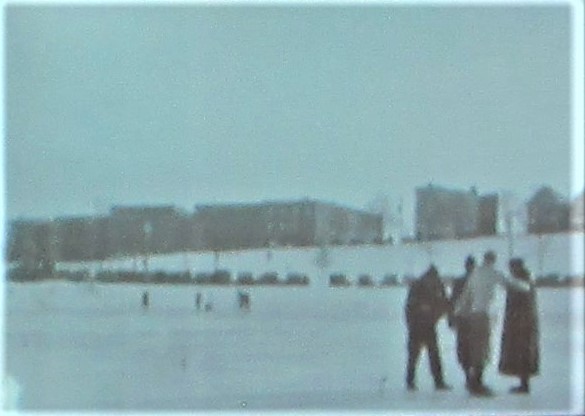
But some things will always be the same even as the buildings changed. Albanians will always find ways to have fun with each other - here's a few shots of Lincoln Park when it opened in the 1930s. Before the Empire State Plaza was built and the pools there were frozen over in the winter, Lincoln Park was flooded and ice skating was a treat during the winter!
Lincoln Park during the summer 1930s
Ice Skating on the frozen pool in Lincoln Park in the winter 1930s
The South End of Albany is definitely a melting pot of all the cultures that have - and continue - to make it their home. And its urban development projects are a piece of history as well, adding another piece to a fascinating discussion on Albany.

We had a lively question and answer section of our lecture as well! It's great to see so many people interested in exploring local history! We'll be making the trip back to Waterford with our final lecture on March 14 at the Van Schaick Island Country Club (check out one of the delicious options you can order while you're there).
Hope to see you all there for an awesome close to our lecture series!