Tuesday, June 19, 2018

FASNY Lecture


The museum had the pleasure of being able to share some more of New York State’s fire fighting history with the legacy of Harry Howard. Have you ever heard about this important figure in the history of the safety of New York? 
Well, even Christine Lillpopp, Collections Manager at the FASNY Museum of Firefighting in Hudson had to let that slide since it’s apparently a very unfortunate commonality that Mr. Howard tends to get overlooked aside from the streets named after him.

We had a great time learning more about his contributions to fire safety and checking out the displays that were set up around the room. Christine brought some photographs of Harry – which you’ll notice his trumpet that he holds in a couple of them as he was an avid fan and musician himself. 

There was also a display highlighting a few pieces from the Waterford Museum’s collection of items of the multiple firefighting stations in Waterford. We even had someone bring a couple of plaques for the Lysander Button award too so that there was plenty of Waterford’s past –and present – represented at the lecture. It was a wonderful crowd so thank you to everyone who joined us and to Christine Lillpopp for putting on a fantastic presentation!


Since this lecture was a few months ago – it’s been busy here getting ready for the current exhibit and planning for another fun-filled week of the Canalways educational program that I just wasn’t able to type everything that needed to get typed out fast enough! But if there’s something you’re interested in learning more about, come stop by the Waterford Museum to learn some more about the Buttons and the history of fires in Waterford. Or take a trip to Hudson to look around the museum that was originally the NYC 
So to give a few highlights of this lecture: Harry Howard was a foundling child (aka a baby left on a doorstop with a note "I'll return for him later"....and later never came so he was adopted by the family who cared for him) who was always invested in being the best at fighting fires.
Starting as a teenager, his involvement began as a runner for the Peterson Engine Company No. 15, using engines like this image (sorry for the bad quality) of the Old Maid Engine that was frequently used in the 1820s - 1840s.
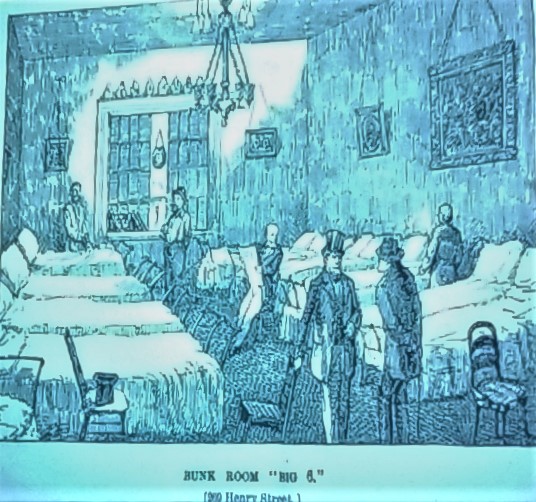
Harry's enthusiasm and work ethic moved him towards becoming elected Assistant Engineer in 1851 and then, in 1867, becoming the NYC Chief Engineer. In this position, he instated several important features - namely the bunking system and the installation of ladders on buildings throughout the city to help aid in safety. 
He was so active that during one of his fights against a blaze, he suffered a stroke at the age of 35 that could have ended his career as a firefighter. But he persisted, although his stroke left him disabled and unable to continue working in the same capacity as a fireman as he had before. Still, his general attitude of public service led him to serve in his retirement as a Public Works Department official.
He continued to remember his firefighting brothers with a large donation ($1,000 in 1895 currency that equals to roughly....$1.2 million) that helped establish the volunteer fireman's house in Hudson. Several engine and hose companies took his name in honor of him and his service.
He never married, although he did love and was engaged to a woman  from Hudson for several decades. The reason they never married? Her parents didn't' approve because of Harry being a foundling baby. So, continuing his lifetime of being a chivalrous man, he respected their wishes and simply remained "engaged" to her until his death, leaving all he had to her.
FASNY Museum of Firefighting is today housed within this museum, continuing its firefighting tradition by sharing with the public its history. 
Other important highlights of Mr. Howard's life as a firefighter:
  • Harry Howard's Fireman Certificate
    He's responsible for saving hundreds of lives and millions of dollars in property

  • Harry was a fan of the old fire engine models - he was known for advocating that Hand Drawn Steam Engines be used as a "last ditch" effort when working to protect the NYC volunteer fire department from elimination
  • Harry was frequently in firemen's parades serving as the Chief Marshall

  • He was the Chief Marshall/MC of the cornerstone-laying ceremony for the Volunteer Fireman's Home

Learn more by contacting the FASNY Museum of Firefighting!


Schenectady Today June 19, 2018 #1038

Explore Waterford, NY with the
Waterford Historical Museum and Cultural Center!


Check out the museum's piece on the Schenectady Today Show - In and Around the Capital Region!

Click on the title to watch on YouTube
Skip to 40:48 to hear about the museum

Big thanks to Ann Parillo for including us in the lineup today with some other great guests with interesting stories to tell.


The museum season runs until October 28th. 
Our hours are: Tues - Sat 10am-3pm & Sun 12:30pm-3pm


Explore Waterford, NY with a visit to the Waterford Historical Museum. Our 2018 exhibit, "Water & War: Waterford's Routes and Canals Through Conflict" is on exhibit this summer. It highlights the military history of the area, noting the connection between WWI and the opening of the Barge Canal (known today as the NYS Canal System) in 1918.


Take a look at our website to plan your visit and learn more about the opportunities at the museum!


Sunday, April 1, 2018

Make-Your-Own Easter Toys 1912 style

Happy Easter!

With Spring finally arriving (promise I'm not trying to jinx it with a fifth Nor'easter or anything...) and Easter weekend upon us, how did you prepare? Some of us make colored eggs of varying artistic talent or hunt for plastic eggs filled with goodies.

Everyone has their own traditions to celebrate, some of which may eed a few instructions or you might end up with brightly colored hands when dying eggs...or you still might....pink and blue are lovely Spring shades to wear anyway, right?

Here's an example of some of the ideas for how children could help out with celebrating in the Girls' Make -At-Home Things book. Yes, the picture shows the title as Boys' Make-At-Home Things - that's because the author made sure not to leave the little guys without some projects too....but Easter ideas only made it into the girls book, both of which were written in 1912 and luckily a copy of each is housed within the museum's collection.

The author, Carolyn Sherwin Bailey, was born in 1875 in Hoosick falls and earned her childhood education from her mother (also an educator and author of children's books) as well as from Lansingburg Academy.

So, if you'd like to try out some early 20th century ideas, check out the chapters that had suggestions for the girls to enjoy.


Hopefully the girls will share their Easter toys with the boys; they might have to just make do with their turning lathes and whittling tools...and wireless receiving station. No really, these are the items listed for boys to make at home, hopefully with some adult supervision.

But these things are actually really cool too so don't feel too bad about the guys being left out of the loop with Easter toys.

Click HERE to check out the chapter on making a wireless receiving station.


                                    Enjoy your Easter!

Don't forget to check out what's coming up in April at the museum by taking a look at our website calendar - docent training, canal clean sweep, and pancake breakfast are all on their way!


Boys' Make-At-Home Wireless Receiving Station

A children's book to both entertain and educate, Boys' Make-At-Home Things was published in 1912 to an audience of children with a different set of ideas of how to spend their free time than the more technology-driven past-time projects of today.

The preface reads:

 "Make-At-Home Things for Boys aims to keep boys busy ad entertained. it furnishes them with simple directions for making toys and useful articles, all of which are carefully pictured. the aim of the book, is to give boys an idea of the craft possibilities which lie in the crudest materials, often the waste material of the home and in this way to develop real artistic ability."

That's not to say that there wasn't already some craving to get in on the newest techno craze either (or that there aren't crafty kids with a DIY mindset today either). Considering the time the book was published, that craze would be wireless telegraph - aka radio. 
Invented in 1895 by the Italian, Guglielmo Marconi, it was still relatively new, especially depending on where you lived. The first permanent wireless station in the U.S. was built in 1901 at Siasconset on Nantucket Island. Stations developed across the country and the idea of this chapter was to encourage boys to build their own small receiver to be able to "cut in" on anything that might be transmitting nearby them. Since the first commercial radio station with one-off broadcasts was created in 1920 (KDKA in Pittsburgh, Pennsylvania), these boys had a very Battleship-like game going on in that they might not pick up on anything for a while...


Here's the chapter:


The author of this book, Carolyn Sherwin Bailey, was born in 1875 in Hoosick falls and earned her childhood education from her mother (also an educator and author of children's books) as well as from Lansingburg Academy.

Wednesday, March 7, 2018

Exploring With Saratoga National Park Rangers

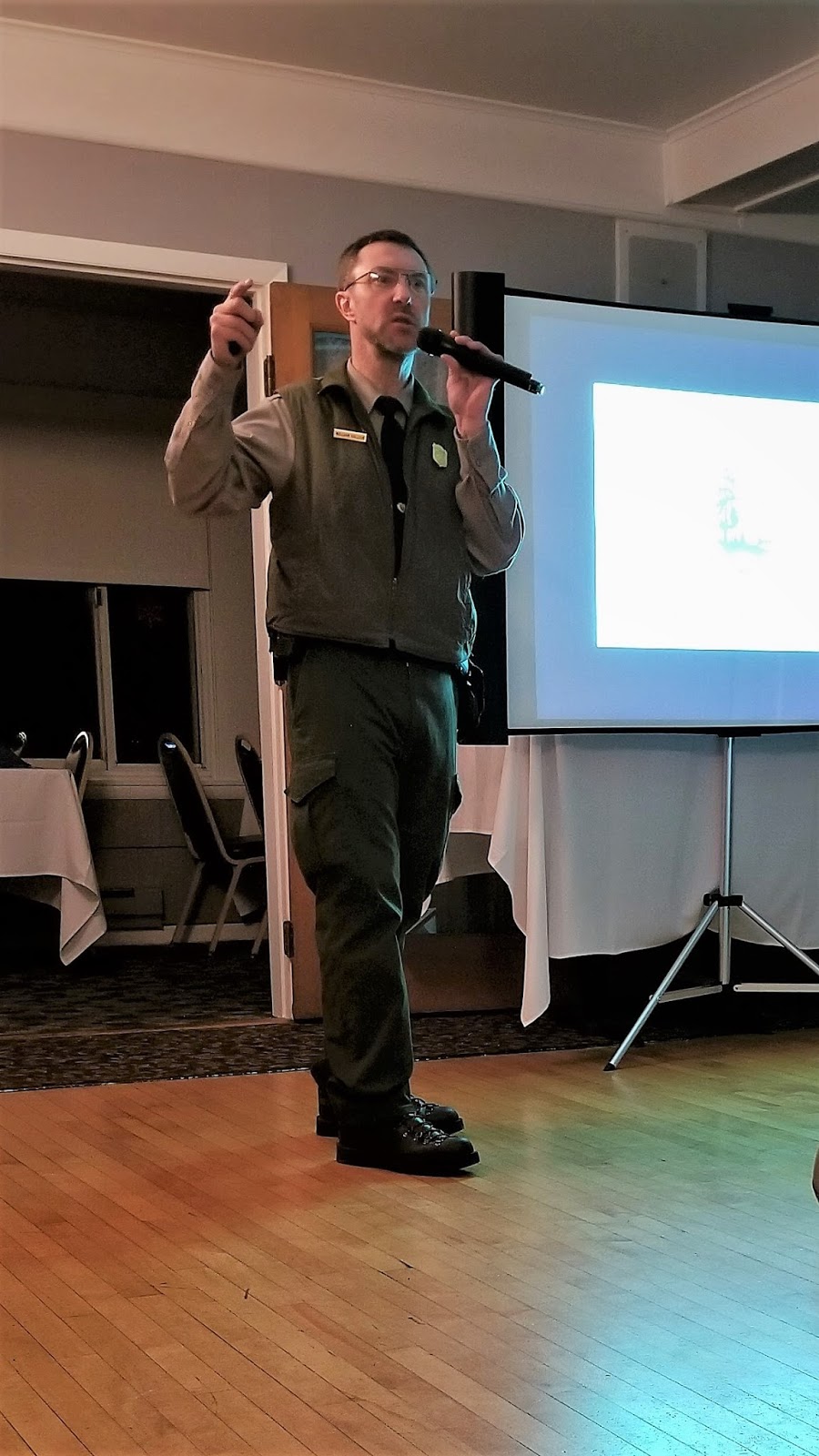
The Winter Lecture Series continued with the wonderful presentation provided by Bill Valosin, Park Ranger at the Saratoga National Park. His lecture was very well attended and we're so glad to see so many interested in this history!

Our virtual tour began with talking about the history of the battlefield and the "battle of the millennium" (New York Times Magazine).  The significance of the battle of Saratoga is widely understood to be the turning point in our revolution and has impacted the course of events in other places around the world. And it's practically right in our backyard! There's so many great reasons you should check out this fellow Saratoga County historic site and what it has to offer.

During this presentation, we explored more in depth the pieces of "history" that have persisted and that many of us were taught in school. Was there a biter rivalry between General Gates and Benedict Arnold to the point that Arnold just had to independently take charge and lead an attack without waiting for Gates' confirmation? What about the three maneuvers attacks  I was taught that the British were planning?

The best way to get this info again would probably be to head over the battlefield and let the rangers there lead your tour (National Park Rangers)- or grab one of the many books that delves further into the finer points as this topic, as you can imagine, has generated a wealth of material from you to choose from. But it's always nice to be able to go to the site and imagine for yourself what you've learned.

Some details may stand out more than others - like the image of the farm boys with no training versus the ominously precise marching lines of the British troops. Except....it was more of a reverse situation. Many of the fighters from the American side were hardened veterans from the French and Indian War 1754-1763. Those on the British side were trained, but were the newer recruits that were still learning all that the best military in the world at the time had to offer - and many probably hadn't seen battle yet at that point. It could be that they were sent to gain experience in the belief that the fight wouldn't be all that strenuous for the British forces, or possibly that it wasn't considered to be too large of a concern. 


There was also communication problems for the Crown forces too, with our presenter making sure to stress the "Crown" portion of their title. Why? There were British, German (well, from one of the Germanic states like Hesse where our Headless Horseman hailed from - Germany didn't officially unify into a nation state until 1871), and other hired Europeans as well as British-allied native groups that might not have always worked together so well in the past anyway.

We might  want to think of how the aid of Tadeusz Kosciuszko (whose engineering contributions can be seen locally - he even designed the fortifications that had been on Peebles Island) or of Friedrich Wilhelm von Steuben might have gone if they hadn't had a translator with them at all times. 

While not the most accredited form of historical source information, this clip does bring up the language point (and while it is a bit of a stretch, it's Drunk History, you'll enjoy it....)


Wars were coming from other areas of the world at the time too shortly after the beginning of the American Revolutionary War -  war in India (Anglo-Mysore Wars) and then Britain declared war on the Dutch (Fourth Anglo-Dutch War) for selling armaments to their enemies…And of course, France was always just across the channel and waiting for their next fight with their frenemy island neighbors, which just happened to be by joining with the Americans thanks to Saratoga -and Ben Franklin's charm as a diplomat - convincing them that the colonies could accomplish what was considered the impossible.


There is no doubt of the significance of the battle that took place here though - by no means should it seem like these additional details downplay the victory. It was one of the stops that the Marquis de Lafayette made to visit while traveling the newly built canal systems in New York (he passed through Waterford too!) when he visited the United States of America from July 1824 to September 1825. 

But keep in mind that the first battle was on a farmer's land. The area went back to being farming land after the battle. The memory of it lingered, but the sense to preserve the battlefields of the Revolution (and later of the War of 1812) came much later - for many sites, the veterans of the battles were the "tour guides" that might take you out (if given permission by the landowner).

If you were well-connected enough to be able to get in touch with him, General Philip Schuyler was known to take guests out onto Saratoga Battlefield from time to time. By the 1830s, the major sites like Saratoga were often referenced in part by the growing trend of guidebooks now that travel was being popular thanks to canals and railroads.

The path to preservation was in large part due to advocates -
like that of President Franklin D. Roosevelt, seen in the picture
below with a rare glimpse of his legs and his leg braces


But it took a while for the site to become protected in as much as there would be large efforts to keep it from being developed over any more.

It took until 1927 before it was authorized as a New York state historic preserve, and then it was made a part of the National Park System in 1938 when Saratoga National Historic Park was authorized by Congress.

There are reports too that during both battles at Saratoga, the soldiers killed in battle were buried pretty much where they fell with barely enough dirt and leaves to cover them.

And since it was on farming land, the plow had done some damage over time to the field in regards to where the skeletons were (that hadn't over time been dug up and sold as souvenirs...) and there's always the debris from all the tourists and the re-enactments and other ongoing events.

But that doesn't mean that history isn't being uncovered more and more each day!
Archaeological studies of the site are ongoing.


Take it from someone who has spent a few internships in the backroom of an Archaeology lab and collections area - it takes a while for these systematic studies to be analyzed even without the added information from non-invasive excavations like ground-penetrating radar.

That layer of beer bottle tops has to be treated the same way in records-keeping as those that contain the musket balls that we need to double-check aren't very convincing reproductions or that layer with the human remains that deserve an extra amount of caution and care.


And be sure to keep checking in on the most recent find from the rangers - a letter that went up on Ebay from a soldier at Saratoga writing home that could potentially change the way the first question posed at the top of this blog page has been historically answered.

According to the letter, Gates and Arnold worked together just fine. And since Arnold was a social ladder climber to the point of betraying the country he had been fighting so talentedly for during Saratoga, it makes sense that he would try to be besties with someone who might be able to help him with that goal.


So the perceived "laziness" of Gates is also thrown out by this letter too, since it mentions that because Gates and Arnold worked well together, Gates gave Arnold the go-ahead for the task that has since been thought of Arnold taking the initiative because he couldn't work with Gates....


But....and it's a big but....


....They can't get in touch with the seller of this supposed letter  who had since taken the letter off of eBay and so it remains an elusive artifact that the rangers are trying to locate and obtain.


Did you know that Waterford has some Revolutionary War history of its own? You can learn more about it in our upcoming exhibit, Water & War: Waterford's Routes and Canals in Conflict, opening May 4th.

Tuesday, February 6, 2018

Captain Isaiah Rynders: From Dial City to Tammany Hall

The latest lecture in our 2017-2018 Winter Lecture Series was held at the Waterford Historical Museum and Cultural Center in our main exhibit space. We're not exactly known for wide open spaces, but we made it work and there was a nice turnout to pack the room!

Thanks so much for everyone who made their way over to join us and to take a look at the exhibit for the current ongoing art show displaying the work of artist, Dana Hatchett.

It'll still be on the walls for you to check out anytime during our new, extended winter hours: Wednesdays - Fridays from 10am to 3pm until April 13th. It's included in the price of admission to the museum: $6 adults, $5 children/seniors (65+) and free for children under 6 and for our museum members.


We're trying something new this year to make the museum more accessible beyond our usual open season from the first weekend in May to the end of October. Tell us what you think!


Russ VanDervoort presented another of his great lectures, taking a look at the life of Captain Isaiah Rynders, a Waterford native that become a famous (or infamous, depends on how you look at things) figure in New York and national history.


He had a variety of occupations, from a sloop ship captain that he earned from his teenage years at home in Waterford - a title he kept with him after moving onto other fields of interest - to a riverboat gambler, to a founder of NYC's "Empire Club", to a Tammany Hall boss, and even a U.S. Marshall thrown into the mix to keep things interesting for himself. He had some friends in high places too, like Martin Van Buren, James Polk, and James Buchanan. You probably didn't know that although not mentioned by name, a character from Gangs of New York is based on the captain from Waterford.


After gaining some notoriety as a "sporting man" (aka, a gambler) in newspapers around the country thanks to an incident in 1823 at Natchez, Miss where he was the victor in a fatal duel. Yes, Hamilton-style except with bowie knives apparently instead of guns. Fleeing from the area, Rynders moved to New York City and opened up a public house on Park Row in the Spring of 1844. This building would become the meeting place for the "Empire Club".


But Captain Rynders' era of influence was mostly from 1840 - 1860, during which time he used Tammany Hall to...persuade...voters and newspapers in favor of the Democratic Party over their opposition, the Whig Party (the party which the museum building's original owner, Hugh White, was a member of during that time when he started his three-term career as an Assemblyman).


Riots became a popular tactic of persuasion, with Rynders' name usually enough to earn the results he was looking for in elections. This was true for both city politics and local politics, with the 1844 Waterford election a good example.


Rynders also was mentioned in newspapers, something that he tried to keep tabs on in case anyone required a personal meeting to amend any previous comments or reports that didn't sit well with the captain, for good qualities too.

In addition to being praised for his oratory skills, there was also a report of how Rynders' group of Tammany Hall men had their heroic moments too.


But, his tide of influence was receding by around 1857, when he pulled away from Tammany Hall and joined the Native American, or the Know Nothing political party. His affiliation with Butcher Bill Poole and his "Butcher Boys" gang lost some of the respect that he might have had.


An example of that loss of favor is his failure to end the Policeman's Riot when he was called to speak with both sides. Instead, he had to run for cover as he was pelted with rocks rather than the praises his impromptu speeches had previously received.

But he was back into the sea of politics soon enough, appointed U.S. Marshall by President Buchanan. By 1862, he is backing NYC Mayor Fernando Wood in Wood's attempt to withdraw New York City from the Union and make it it's own sovereign nation.........

Now, coming from upstate New York there are times it might seem like the city is a foreign country but you can probably imagine that the concept never actually was considered by anyone else. With reports in some newspapers that don't paint Rynders as a typical citizen of New York, such as one that claimed that the captain was heard to make the statement that if he fought at all, "it would be on the side of the south", it's not hard to imagine that he would be getting into more riots despite his age (he was born in 1804 but clearly kept himself active).

After publicly opposing in 1863 the Federal Government's right to draft men to fight in the Civil War, Rynders influenced the Civil War Riots of the same year. According to reports, over 1000 rioters were killed in the violence, many of which had been gang members that were once aligned with Rynders when he was the de-facto boss of the Five Points area.

After the war, it seems like Rynders remained as involved as ever in his favorite endeavors: being a "sporting man" and political events. His final boxing match was at the young age of 63, he then returned to focusing on rejuvenating the Empire Club and was elected President of this organization. The captain passed away in 1885 and is buried in Waterford Rural Cemetery beside other Rynders family members.


Captain Isaiah Rynders left behind a lasting legacy - which also includes a drink named in his honor:


Don't miss out on our next lecture on February 13th at 7 pm at the Van Schaick Island Country Club (201 Continental Ave, Cohoes). Presented by Saratoga National Park Ranger, Bill Valosin, we'll learn more about the interesting history of our county with The Battle of Saratoga.

Admission: $6 not-yet members  $5 museum members