Friday, April 24, 2020

Throwback 2019-2020 Lecture Series - Part 2

Hudson Mohawk Industrial Gateway Executive Director, Michael Barrett, shared a presentation on the Trans-Continental Railroad. A transportation feat that was a monumental undertaking in its time, it had some local names attached to its creation as these families expanded west with the country. Built between 1863 and 1869, it connected existing train lines to the Pacific Coast.  

Some familiar names tied to this project that have some local significance (or at least well recognized as influential in New York history) are Charles Crocker, Theodore Judah, Leland Stanford, Brigham Young  and Thomas C. Durant. Many others were involved in this venture, with fortunes made through investments - some more honest than others. Another local note: the engines used in the ceremonial opening of the lines had parts with iron from the Burden Iron Works. 

Thea brought several resources that attendees could look over
 before and after her presentation. There was a great level of
 audience engagement with her lecture as well!
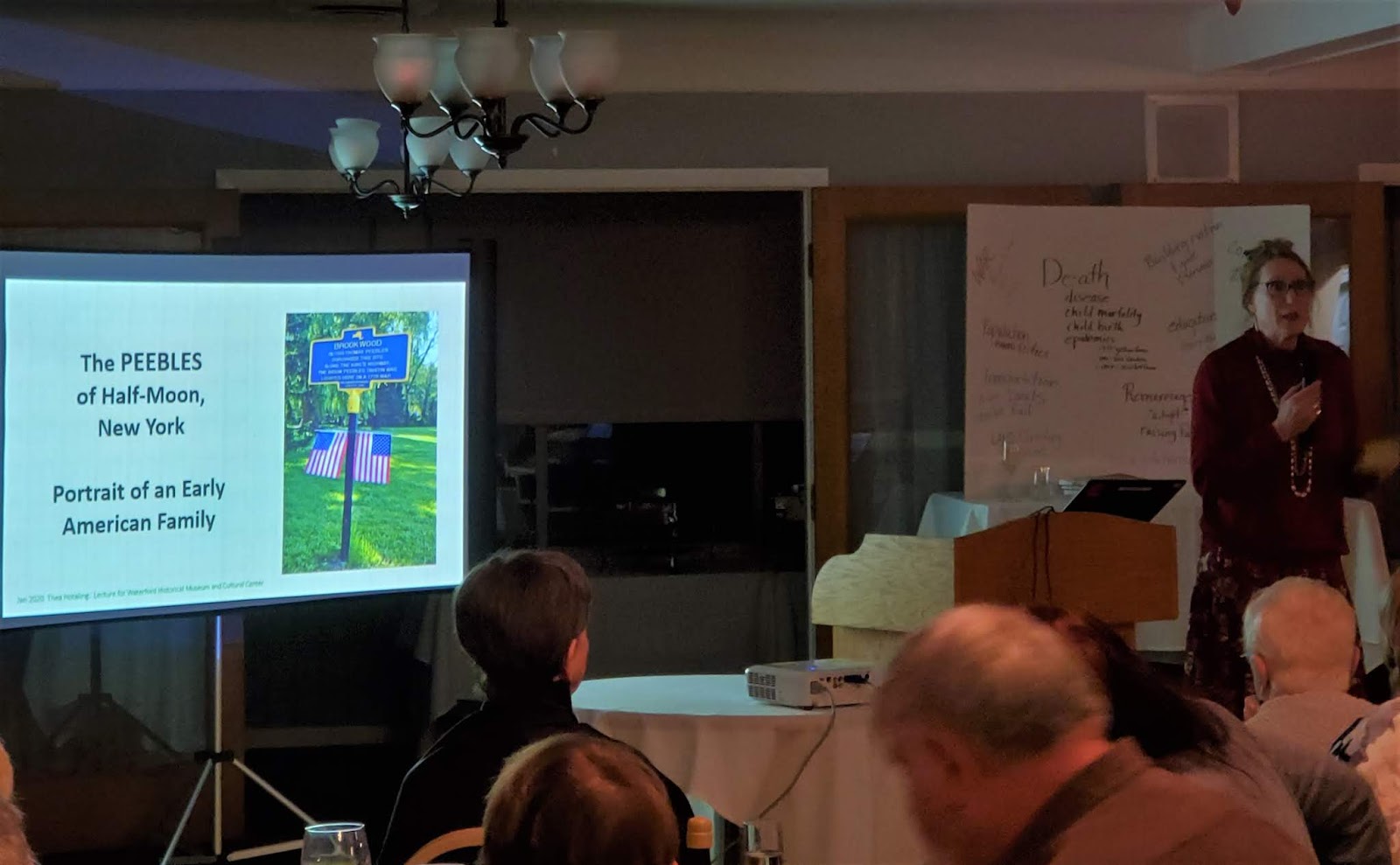
Thea Hotaling, owner and historian of Brookwood Historic Building presented her extensive research on the history of the Peebles family for our lecture at the start of 2020. It was a full house - we even had to drag a few tables over to include everyone who wanted to hear about this prominent family with ties to Waterford, Halfmoon, and Albany. Of course, there is some obvious name recognition with Peebles Island State Park as well, as the family did own this island in the Mohawk River delta that now serves as a New York State Park and site of the NYS Office of Parks, Recreation and Historic Preservation.

The original owners of the property that is now referred to as Brookwood, were the Peebles family. It was a lucrative piece of property even its early days, being ~15,000 acres beside the Hudson River and having its own freshwater, as well as being situated alongside the Great Highway from Albany to Canada. Thomas Peebles married Elizabeth Bradt of Albany, from one of the early Dutch families of Albany - her father was Gerrit Bradt (son of Daniel Bradt and Elizabeth Lansing) and her mother was Maria ten Eyck. Those are all some recognizable local names- Oh, and her grandmother is Geeritjia Van Schaick...so essentially relatives were everywhere in the neighboring communities. Which might've influenced the decision to brave the then frontier-like area of this this estate. The Peebles manor was constructed in 1763, becoming one of the 12 founding families of the Waterford/Halfmoon (Halve Maen). 

Thomas had been  appointed by the royal authority in 1770 as a Justice of the Peace for "the territory consisting of Saratoga County". After he passed in 1774, he was buried on a small knoll on the property by "Brookwood Creek" that began the family cemetery. Elizabeth had five children to support, which she did by transforming her manor into an inn and tavern that became known as the Widow Peebles’ place. It was marked as such on maps like the 1779 Isaac Vrooman map commissioned by George Washington.  . 

In 1783, when notable figures like Washington, Alexander Hamilton, and Governor Clinton were on route to see the battlefields at Bemis Heights, they stayed at this inn, referencing it in letters. This likely contributed to Elizabeth's mention in the 1788 list of innkeepers - the only woman to be included. The tavern continued to host notable figures, like James Madison and Thomas Jefferson who were also touring the revolutionary battlefields in 1791. The tavern was turned over in 1795 to her sons, being known as “The Child’ Place” before it eventually become known as Brookwood. The children became involved with the business, civic, political and religious development of the local area. 

Edward Lamson Henry's "Early Days of Rapid Transit". Albany Institute of History and Art
The property was well known locally but also was featured in “A Pocket Guide for the Tourist and Traveler along the line of the Canals and the interior Commerce of the state of New York”.  Tourism on the canal brought many to areas that otherwise would not have been traversed - Waterford had been at the height of sloop navigation on the Hudson River, but like today, many toured the route to see the engineering marvel and the sights of New York State. Packetboats like the one in this painting at the Albany Institute of History and Art were used frequently, waning in 1853 when railroads were completed around the state.

Hugh Peebles, the eldest child and to whom the inn's ownership and operation passed, served during the Revolutionary war in some significant positions, including as private secretary and Quartermaster for Colonel Jacobus Van Schoonhoven, the Saratoga Campaign, and likely one of the first companies to defend Bemis Heights under Gen. William Alexander.  In 1784, as the military representative, he signed the Treaty with the Six Nations at Fort Stanwix (and again in 1789 in Albany). He became an influential figure locally by serving as: Member of the Masonic Lodge in Albany (Master's Lodge No. 2), Queensbury Pay Master (military appointment 1786), an original board member of the first local public school system (1796), Justice of the Peace for Half-Moon (1797;1800), Halfmoon Commissioner of Taxes and Superintendents of Highways (1799) and even campaigned to become an Assemblyman for Saratoga County in 1799 (finished #7). Brookwood was passed along to his eldest child, Abbie, after his death in 1840.

His sister and the eldest daughter, Maria, married Abraham Livingston and settled in Stillwater. Livingston served in the 1st Canadian Regiment and was present at both battles of Saratoga, later serving as Captain in the New York Levies. The Peebles' third child, Rosanna(h) married John Welch, who also served in the Revolutionary Way in Col. Sheldon's Dragoons and was a part of the Burgoyne Campaign. They relocate to Welch's hometown of Litchfield, CT where they are buried. 

Peebles Island Cultural Resources Map 2000 depicting the boundary of the
NYS Park along with existing buildings and earthworks and the
 sites of former buildings and earthworks. 
Gerrit Peebles, was appointed Captain in the NY Militia in 1789 and married Elizabeth Survatt in 1799. He entered into the merchant business, becoming highly successful and influential in the local area. He moves to the growing Lansingburgh village in 1800 with his family, his wife and youngest son he tragically loses in 1811. He is elected Sheriff of Rensselaer ounty in 1813, remarrying in 1818 Maria Van Schaick (cousin to Maria Gansevoort Melville, mother of Herman Melville - again, some pretty recognizable names here). 

Gerrit purchased Haver (Oats) Island from the Van Schaick Family, after which the island took  the family name. By 1862, his son Anthony Augustus owns the entirety of the island. Gerrit died in 1841 and was buried on the family property, but later re-interred at Troy's Oakwood Cemetery.


The youngest, Gertrude Peebles, spent most of her childhood as her mother's right-hand person, sometimes being referenced in letters from travelers to the inn like Venezuelan Revolutionary, Fransico de Miranda . She married Benjamin Tibbits, the brother and partner of  the very successful mercantile firm G. & B. Tibbits Company, in 1793.  They had one son together before Benjamin met an untimely early death in 1802. She remarried in 1807 the widower Rev. Dr. Eliphalet Nott, clergyman, education, scientists/inventor of over 30 patents, and business (he also became nationally known in 1804 for his sermon on the "Death of Alexander Hamilton"). She moved to Schenectady with Nott and they have a son in 1809 - it is largely with Gertrude's assets that Nott buys substantial land here and laid the foundation for the expansion and growth of Union College, of which he was also president (and RPI too).

A connection to the White family: Gerrit Peebles, was a trustee of the Cohoes Manufacturing Company (incorporated 1811), which later sold the property to the Cohoes Company, which Hugh White was one of the incorporators and served as its president.


Photo from the Library of Congress taken 1969 by Jack Boucher. There are a few more worth checking out that show water still in the Cohoes Power Canal at this point, which is now the Power Canal Park by the Harmony Mill Lofts.

Thursday, April 23, 2020

Lecture Series 2019-2020 Throwback - Part 1


 As everyone practices social distancing and staying at home, museums are also closed - or remain in "off-season" until things go back to normal. Some places are taking advantage of all the virtual and remote opporunties to enjoy their museums - Waterford Historical Museum and Cultural Center has an audio tour available on the UniGuide Audio Tour app available for FREE through Google Play. Depending on your location, you may be out of range - but you can always participate in the cell phone tour offered by the Mohawk Towpath Scenic Byway (your standard rates will apply for this one - check  out #18!). Both are options that you can take advantage of without having to step foot inside the museum. Also check out our website for pages on local history, exhibits like the Making Waterford Our Home immigrant heritage project,and explore our online database of artifacts! Our social media pages are also still active with posts on Facebook @waterfordhmcc and Instagram @waterford_museum. 

With programs on the backburner for the foreseeable future, here's a throwback to the 2019-2020 Annual Winter Lecture Series at the Van Schaick Island Country Club - which seems appropriate considering we had some wintry weather and icy roads this week.

Town Historian, Russ VanDervoort, shared the story of the brazen 1872 robbery of the Saratoga County Bank. Waterford’s prominence as a bustling canal terminal, riding off the business that came from sloop trade, prompted the Saratoga County Bank to open its first location in Waterford. As Russ also noted, there were several other businesses too, such as the 42 saloons, which moved the location of the bank around until it settled on the building still standing at the north corner of Second and Broad Street. Even before this robbery, the bank survived the financial Panic of 1837, burning in the 1841 Great Waterford Fire and hit by counterfeit $10 bills in 1868. 


An example from The Marysville Tribune, November 1872.
The other figures listed on this page are the varying totals
given in articles from other newspapers - the most
accepted figure is that of $625,000
But the theft of $625,000 in cash, bonds, and jewelry (or thereabouts since reports kept shifting the exact figure), made national news. The resulting trial was also newsworthy, as the suspects were noteworthy as well. The bank robber gang consisted of several big names in burglary as a profession, most of which had enough aliases that it makes keeping their stories straight particularly difficult (as they intended). The case was significant enough thanks to the high monetary figure to warrant the Saratoga County District Attorney, Isaac Ormsby, to be involved - who also happened to be a Waterford native. 

The case was full of intrigue as well, including a séance to discover the location of some of the stolen goods and scrutiny over the involvement of  bribery of Hudson police officers, Dyers and Best, to let the 2 gang members arrested "escape". Dyers eventually admitted on the stand that he had been paid to be a witness was currently under indictment for robbing a safe....and Best outrighted stated that he'd been given $60 and a revolver to let them escape, he'd later gone to NYC to receive some more, and that "Any  previous testimony that I have offered in Waterford and Ballston Spa has been false and I knew it was false when I gave it."

The Ballston Spa courthouse was packed with crowds, as it was the event and talk of the area - which the opening prosecutors took full advantage of since their opening statements took a full hour. The suspect, known as Peter Curly, was the focus of this trial. He was identified by Dyer and Best, with speculation by the servant girl of the Hovenburg family that lived in above the Waterford bank that he was there based on noticing that one of the masked men had large ears that Curly quite obviously also had. But, he made the news for another, more amusing reason: the local Waterford and Ballston Spa area ladies who clung to every detail of the suspects’ trial. It wasn’t for the brilliance of their plan, but for the fact that someone so good looking couldn’t possibly be responsible (or jailed away from their eyes even if he did the crime). 


Ultimately though, the suspects were acquitted, citing that the various other witnesses couldn't be totally certain that they recognized Curly. A celebratory evening was held at the Sans Souci Hotel in Ballston to thank the jury and their defenders, with the money that may – or may not – have been the product of the heist. A few bags of money were found later in NYC that were traced to this robbery and in other areas as time went on, but these suspects were never jailed- at least for this crime. The building also had other roles, such as serving as a funeral parlor, before becoming a private residence. 


Keep on the lookout for parts 2, 3, and 4 to cover this series! 

Wednesday, October 30, 2019

Hallowe'en Greetings From 1935 WHS


Halloween - a holiday "invented by the candy company" to quote Disney's Hocus Pocus - has been a staple of American culture.

Halloween is based on traditions from the Celtic festival of Samhein where people would light bonfires and dress in costumes to ward off wandering dangerous spirits as well as being a time of harvest. If you're interested in the connections of this ancient pagan festival to today's events, you might want to find The Book Of Hallowe'en by Ruth E. Kelley (1919), Halloween: An American Holiday, an American History by Lesley Bannatyne (1990) or Traditional Festivals: A Multicultural Encyclopedia, Volume 1 by Christian Roy (2009).

The concept of Halloween as we would recognize it came about in the early 1910s. Thanks to the hilarious series of "Drunk History", you might have already been aware of what the story is behind "trick-or-treating" in the sense that we know. Basically, one woman had enough of her garden getting pranksters' wrath and so decided to sponsor a party so awesomely sugar-infused and packed with alluring games and activities that essentially she distracted them all night from going on a version of "The Purge" on her heirloom roses. And parents liked that it kept their kids contained and happy, the town was cool with the idea of not having as much vandalism (and possibly generating some revenue from events), and her plants survived the night, so it just...continued and spread across the country.

Of course, "Drunk History" explains it in a far more amusing manner, so click on this link to check out their Halloween episode for more laughs.

By 1935, Halloween was still known as "Hallowe'en" and people were making homemade costumes and "trick-r'-treating" had been around long enough that it was forming into the current tradition - the first known print reference to "trick-or-treat" was in 1927. This was in the Alberta County Herald so not technically from the U.S.A but is North American... At least it's liked better in Canada than in the UK as apparently, while Halloween is a thing, it's hated over there! Apparently, it can be viewed as "too American" and steals the spotlight from the U.K.'s Bonfire Night. Oh well, more candy for us.

Full-scale creepy-themed decorations had been a prominent part of the 1920s when the Beistle Company produced a Halloween-specific line of party decorations. This continued into the 30s  with Bogie Books, published by the Dennison Manufacturing Company that offered craft and party ideas solely for Halloween. The 30s are also the era of the Golden Age of Monster Movies too, with Dracula (1931), Frankenstein (1931), King Kong (1933) and The Invisible Man (1933). But, even so, one of the most popular costumes in the 30s based on a fictional character turned out to be Mickey Mouse (debuted in 1928). While trick-or-treating waned during World War II due to sugar rationing among other reasons, it was promptly picked up and has carried on steadily to today.

In the Waterford Historical Museum and Cultural Center's collection of documents is this "Hallowe'en Greetings" from October 30, 1935 of the Waterford High School newsletter.


Inside are the usual columns, with just one section dedicated to mentioning Halloween as "Hallowe'en". But it is interesting to read the "Movie Reviews" , "Fashion Flashes", and other things they felt worth noting, although the "Did You Know That?" and "Home Rumors" sections read a little like a Gossip Girl narration with lines like:

"Say, did you see Hank Button with Ruth Rebman? My "G" Men on Middle Street tell me that this has been going hot and heavy for quite some time."


"Oh! was I surprised when I saw Vera Currier, one of the few silent women, dancing around with her brother! She danced like Ginger Rogers and he wasn't so hot either." 

"What eighth grade girl did yours truly catch smoking a cigarette?


Have a safe and happy Halloween from the
Waterford Historical Museum & Cultural Center!


Wednesday, October 2, 2019

Help Make Hidden Gems Shine


Who doesn't enjoy finding something that seems like only a few, maybe only you, have found before? It's why so many often go out of their way to find those places that can be called "hidden gems". Bear with this article's wonky text changes - Google blogspot isn't always cooperative and there have been multiple attempts to try and fix it....with this being the end result....

Anyway, museums are often treasure-troves, with their collection of artifacts and eagerness to invite people to explore what's around them.

Websites and social media have made finding these places even easier - your GPS on your phone or in your car might even have a function that pulls up all the museums and heritage spots that are nearby. It's so easy and convenient, you might wonder why it is that you can't find more of them now than if you were searching for them, maybe ten years ago.

Here's how you can help make these hidden gems sparkle!


Physically Visit Sites
The easiest way to help hidden gems is to support them with your admission fees. Not every gem is free just because they’re educational or a non-profit. “Your support directly helps us achieve our mission” signs do literally mean we’re grateful that you help us splurge and turn the lights on, have running water, and maybe even the luxury of air conditioning. Having "Museum" in the title does not mean that these sites receive public funds like a public school does. Admission fees are vital towards making sure small sites can actually open their doors to visitors.

Volunteer
Often these gems nestled back from the main roads are actually PRIVATE organizations (so your taxes aren't being shared with these gems) that are created by forward-thinking residents with a focus on preserving their history and heritage. They operate either entirely or mostly on volunteer time and efforts from everything between giving tours to scrubbing the toilets.

Become A Member
Even if you know you can't visit often or just not able to volunteer (or don't want to make that commitment), memberships can offer  monetary support AND you get notifications on what's going on at these sites. It's like your coffee club card, but for historical exhibits, events and programs!

Follow & Share On Social Media
Hidden gems don't want to be too hidden. The struggle is very real with getting awareness out on a virtually non-existent budget. Spread the word and show off your visit to these sties to not only keep your memories of the place, but encourage others to come and make their own!


Donations
Nobody likes a choosing begger. Especially one that continues to ask for more and more. However, donations help small museums and historic sites with the struggle against 3 potentially operation-ending assumptions about them.

Assumption 1:
These kinds of sites are always guaranteed money from my tax dollars. Donations are really "extra" money from me that just line somebody's pockets. It's a non-profit after all - it's supposed to struggle or it's actually for-profit!

No! So very, very much no! All of those "profits" at historical and educational sites go directly towards programs, facility care for visitors' consideration, exhibits, and daily operating expenses. Even non-profits have to pay property, utility, sewer and all of those pesky bills that you do. So what does being a tax-exempt organization actually mean? No federal income tax or state sales tax.

Assumption 2:
There must be somebody taking care of things. They really only ask for support because they want more money or whoever's supposed to be doing things just doesn't want to do their job.

So, while taking a vacation sounds wonderful -as does being offered some extra much-needed- this is another no. Truthfully, if a small museum or historic site is lucky, there might be 1 part-time staff. As you can imagine, that means wearing many, many work hats as the sole person at the site every day. Which, no matter the size of the gem, can be a hefty set of tasks that needs a hand year-round from volunteers like you!

Assumption 3 - The Most Dangerous Assumption:
It's not like they're going anywhere if I don't manage to visit or help out. It'll still be there next year.

A hidden gem is totally, completely, utterly, absolutely reliant on YOU to keep it around! The hard reality is that not even being labeled as "historic" marks a gem safe from closure, repurposing, or demolition for many of these small museum and historic sites.


For the WHMCC, it became a museum after it had been an apartment building that was sold off and slated for demolition to make way for another supermarket. It was only thanks to quick thinking and scrambling by local residents that it was saved. It can just as easily go bankrupt and be sold off to be turned into apartments or something else once again. Its collection would then be parceled out to other organizations or be sold off to pay any final expenses. There is no guarantee, not even in National Historic Districts, that things will stay exactly the same as you imagine them to be.

This isn't meant to sound as alarmist as it might read, but it should act as a reminder that these hidden gems need YOU to help keep them around. Visit these gems help to preserve and share the history of their area. Often, even the smallest site has so many things packed inside on its walls and with its objects. Or, you learn something you'd never even think of just by talking with someone there!

These kinds of gems usually do their utmost to find ways to incorporate other points of interest to help broaden and diversify the stories they share, which creates a fulfilling experience and has the added benefit of finding more places to explore!

Hidden gems that really shine can help disprove the mindset of "I can just google it". They help encourage visitors to do more digging and maybe help excavate and polish another great gem.


Thursday, July 25, 2019

Waterford Porch Crawl

Come sit a while on our porch....

The Waterford Historical Museum & Cultural Center is hosting a new event this coming September - the Waterford Porch Crawl

This is a relaxed, leisurely walk (or drive for those who'd prefer or require some vehicle assistance) around the Town and Village, with stops at some of the community residences that are opening their porches for guests. 

Enjoy an opportunity to talk about the architecture you'll see around Waterford and to learn a little more about the history of the area while getting to know and enjoy the Waterford of today.

The crawl will begin at the White Homestead at 2 Museum Lane. This is the only place to register and crawlers will receive a bracelet with their admission to signal your participation in the day's event. Admission also includes an orientation to the event, starting with the museum and its exhibit space. Participants can skip the exhibits inside and come back anytime during the crawl before 3pm. Crawlers will receive their map with all the destinations on this self-guided crawl upon registration, including places like the Hurst Visitors Center and the Waterford Community/Senior Center.

Just a reminder that it's a PORCH crawl. That means all our participants will get the chance to wander the neighborhood and see the historic homes as they move from porch to porch. There won't be any stopping inside during your visit with home owners sharing the history of their home. After all, these are peoples' homes and the insides...well, pretend like you weren't expecting company on clean-up day and now imagine there's a surprise party at your door. Yeah, you'll probably be herding everyone to stay out on the nice porch outside too. Who doesn't like to relax a little on the porch if you've got it, right?

Restrooms are located at 3 locations: Hurst Visitors Center, the Waterford Community/Senior Center and the Waterford Historical Museum & Cultural Center (museum open until 3pm only).


Parking is available at 2 locations: Waterford Historical Museum & Cultural Center and the Waterford Community/Senior Center.  These lots are free for participants for the duration on the program. Parking is also available on the street (limited) in the village and may be available on Peebles Island, although these spots may come with a fee.

Thursday, May 9, 2019

Victorian Waterford Garden

Welcome back to WHMCC! 

Our 2019 season is open for visitors to stop by the Homestead in Northside Historic District

The Waterford Historical Museum is presenting "A Place For Nature In Victorian Waterford" this season. As you might expect with "nature" in the title, there are lots of pretty flowers and other plants to add a little color to the room.


While WHMCC is an exhibit-based museum (aka there are no rooms set up like the White family just stepped outside for moment), these kinds of exhibits are a fun way to bring to light the history of the house too. This exhibit is set up like a 19th century indoor garden space, complete with palm plants, orchids and, of course, a fern. You can't not have a fern!

Gardens were in public and private spaces during the Victorian era, as people attempted to bring nature more into their lives and into their personal space. Indoors gardens were a popular way to do so, sometimes with the effect of being surrounded by plant life in your own parlor. The importance was not just having a garden to show off to everyone that you could afford to maintain it (or just were able to not kill the plethora of plants....as some of us may or may not be able to make even the hardiest of plants give up after too much TLC...).

Nature in this era was simultaneously symbolic of the wild and untamable and the carefully cultivated; the romantic and spiritual qualities of connecting with nature on another level, and yet obsessively scientifically cataloging individual aspects of the world.


Sketch of the White Homestead taken from History of Saratoga County by Nathanial Bartlett Sylvester
Sketch of estate taken from History of Saratoga County
by Nathanial Bartlett Sylvester
The White estate in Waterford is a great example of the craze for gardens. Hugh White had his house built in 1830 along Saratoga Avenue/NY R32 with other mill/business owners in what is called "Mill Owner's Row". Coming from the founding family of Whitestown, Hugh operated the Harmony Mills factory and a variety of other businesses in addition to being a Congressman representing Saratoga County. The White Homestead is built in the popular Greek revival style for this time and had a conservatory attached to the southern end of the mansion (demolished 1950s), with several graperies and greenhouses on his meticulously tended land. He had the added pleasure of having his father-in-law move in across the street from him in a building with a matching façade and his own outdoor garden. Their gardens become known as a "friendly" rivalry (it was his father-in-law after all) between the two properties that were the first thing introducing anyone coming from the bridge connecting to Cohoes to Waterford.

This period also saw the development of the natural sciences, the park movement, the rural cemetery movement, and a boom in American art culture and literature all relating to nature - Herman Mellvile's house in Lansignburgh is celebrating his bicentennial this year! Waterford wasn't isolated enough not to be affected by these trends, with its impact still able to be seen in the landscape today.

This exhibit will run the museum season until October 27
 Admission $6 adults $5 children/seniors(65+)

Upcoming spring & summer events:

Paint & Sip on the Porch - June 8
12:30pm-2:30pm(RSVP Required - limited seating) $25 non-members $20 members

Waterford Steamboat Meet - July 6 
10am to dusk. WHMCC is not a vendor at this event, but it's a great way to view some interesting boats and the museum is just a short walk or drive away to come visit us!

"Along the Erie Canal" Author Open House - July 20 
1pm-2:30pm. $6 adults $5 children/seniors - Author Marvin Bubie will be on site to sign copies of his book and to discuss his research on the towns and villages that he's done along the Erie canal.

Waterford Porch Crawl - Sept. 14
1pm-4pm. Registration at the museum 1pm-3pm. $5 per person
Volunteer your porch in the event today! Learn more by contacting info@waterfordmuseum.com

Waterford Tugboat Roundup - 20th Anniversary - Sept. 6-8
Waterford Harbor Visitors Center -Stop by the museum's booth during the day.

Tugboat parade on Friday (usually around 6pm) & Fireworks on Saturday (around 9pm).

WHMCC doesn't have the daily schedule - we're just a participant! - so double check times with the Town


Special Thanks To Exhibit Sponsors:


One Day Signs

Valoze’s Greenhouse, Inc.

Felthousen’s Florist

Hewitt’s Garden Center

The Garceau Family

Patricia Burke

Teri Patton

Monday, May 6, 2019

Dopplegangers & Crystals & Waterford, NY

Meeting someone with the same name as you can be funny and maybe even a little frustrating given the right circumstances. Bob, meet Bobby; Cathy meet Kathy. Same thing goes for towns, villages and cities. That's not as much fun if the high school exchange students fly into Albany, Georgia without realizing that particular Albany airport was a few hundred miles off the target (true story).

So just how many Waterfords are there? Well, there's probably a Waterford in nearly every state (CT, OH, MI, PA, & NC the most recent WHMCC encounters with dopplegangers), and there are a lot of places that start with "Water" that may confuse people looking for say, Watertown.

View of the confluence of the Mohawk & Hudson Rivers in Waterford.
This picture was taken prior to the 2000 construction of the Visitors Center and
 waterfront park area that is open for visitors to the canal


WHMCC is also very often misidentified online with the Waterford Museum of Treasures and the Waterford County Museum - both of which are located in Waterford, Ireland. There have been instances where people have made appointments to meet with the WHMCC director only to learn they've been speaking with the United States of America rather than Ireland. Probably a slightly longer commute to reach us...

In case you're interested here are a few snapshots of a few of such conversations:


Waterford didn't take on its current name until 1794 when the village was incorporated. The Town of Waterford remained a part of Halfmoon until 1816 when the Town Board members living in what is now Waterford had enough of having to travel up to Halfmoon for monthly meetings. it was only thanks to the frequent use by European and then American military forces using the "Great Highway" route from Albany into Canada (Second Street in Waterford from Peebles Island State Park) during colonial times through the early 19th century that the area being known as "the fording place" really stuck as its name.

Before, different areas of Waterford under the Van Schaick Patent, otherwise known as the Halfmoon Patent, went by "Halfmoon On The Hudson", "Halfmoon Point", "Halfmoon Fort" (which was allowed to fall to ruin and be buried and built over to the effect that its actual location is not verifiable today), and....Northside. Northside is still a community in Waterford today and  National Historic District of which WHMCC is a part.

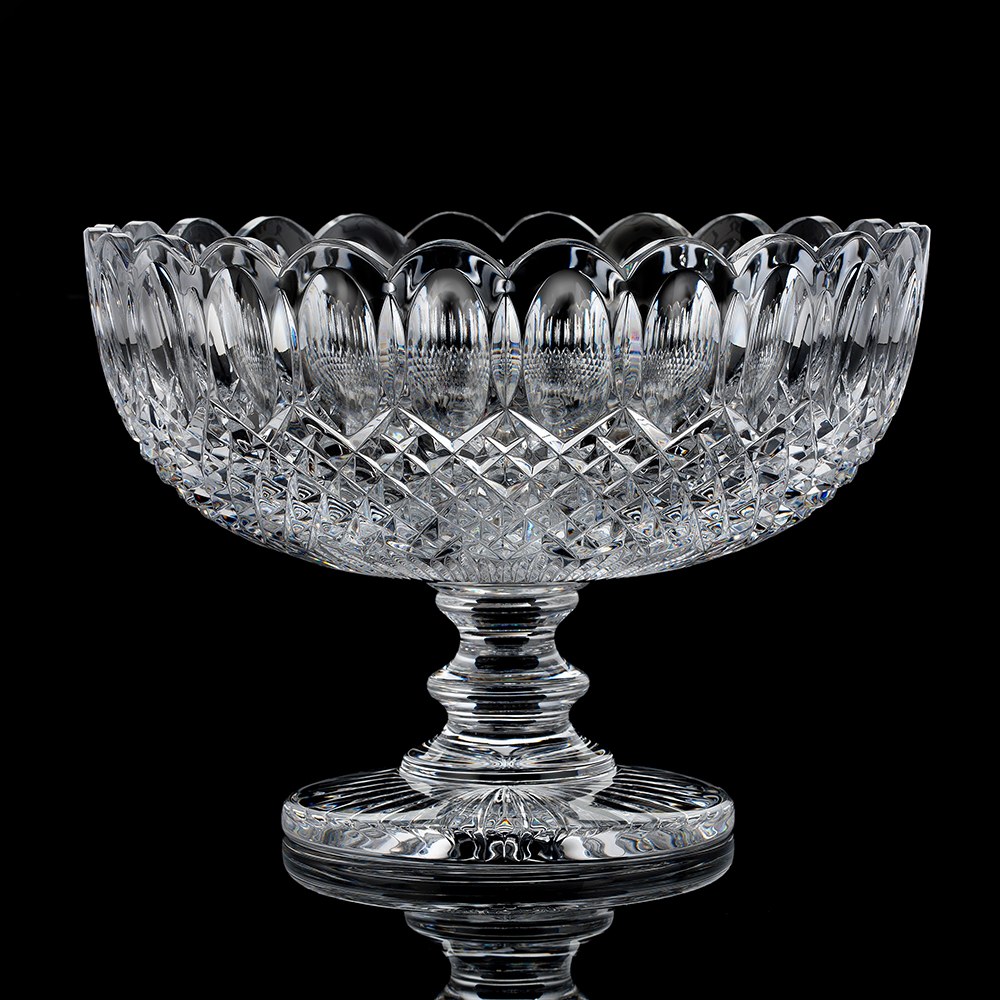
The name Northside refers to being the "north side of Cohoes" despite its location in the southernmost part of Waterford. It was called this due to the many owners of the mills/businesses of Cohoes living in this area of Waterford and a strong desire to be a part of the Cohoes mailing district rather than relying on the Waterford post office. Despite the anomaly that is Northside in name only, of course), the area was generally known as Halfmoon until the American Revolution put more emphasis on its strategic location for movement of troops and supplies than its connection to Henry Hudson and his "Halve Maen" ship's voyage in 1609 that reached to just about modern-day Stillwater. Having a common enough name - Waterford is a descriptive name of a place that can apply to many locations after all - it probably shouldn't be that surprising WHMCC get a lot of questions about Waterford Crystal too. That just seems like an obvious connection since it's a very popular and well-known company.

So, is it some sort of unspoken understanding it's a requirement to have a glass crystal manufactory within your borders to be able to call yourself a true Waterford?

A laughable question at first, but it is a very common request for information on identifying patterns. Or worse, asking WHMCC to repair your crystal...

WHMCC can't offer any other suggestions to help you aside from try using a strong adhesive (Gorilla Glue in its clear form is great for odd jobs around the museum) - it's not that we don't want to help with your valued treasures - we just...can't. We don't have the funds, staff, or resources and....


we honestly have absolutely nothing to do
with Waterford Crystal
.
 

Unless you'd like to donate a piece to the museum's collection of items, we'll just be oohing and ahhing over the admittedly beautiful glasswork with you.


Seriously - as far as Australia contacts us for a potential discount on an item or repair that's "cheap" - aka "free" since we're a museum and a lot of assumptions are made about the lack of price at a museum or historical society or any other 501 (c)(3) organization.


And for some reason, WHMCC comes up in search results on Bing for anything with "Waterford", "history" and "crystal" in your search. This screenshot is from just typing in something that you might enter if you were looking to learn more about a family heirloom, using the phrase "Waterford history crystal". Not really sure why we're so close to the top of the results, but the highlighted site is the one that is typically the reference shared with those who ask WHMCC about Waterford Crystal. Occasionally, we also get asked to help identify a piece of Waterford Crystal. That's understandable since it's not a far reach that if you need help with researching something you contact a library or museum.

So, when yet another request came in from someone out of state looking for a way to identify and possibly repair a cracked Waterford Crystal pitcher, it sparked the creation of this blog article. All in good humor towards those mistaken.

It's not surprising that we get a lot of questions about Waterford Crystal. After all, every Waterford is the same, right? Relax, that's a joke. We're obviously the best.

 But in all seriousness, WHMCC looks to help whenever it can with whatever we can do - just keep in mind a couple of very important details that may influence your planning (just in case this is something that needs a quick fix).

  1. There is a staff of 1 part-time museum professional. Our volunteers make up the rest of the museum by assisting with special events and acting as a docent...not as researchers. Typically, these sorts of questions that really don't fall into WHMCC's area of expertise are only given a very quick internet resource search that you probably have already done as well.
  2. WHMCC does not take on research project requests - we'll schedule a visit for you to come use our O'Connor Research Library & Archive if your questions relates to Waterford NY history (click HERE to learn the difference between a Museum Library VS public library.)
  3. Researchers can check out our online database to view a portion of WHMCC collections 
  4. Double-check which Waterford you're trying to reach - if you're out of state (or country) it's understandable that you can't stop by WHMCC for a quick visit. Researchers asking WHMCC for assistance on research relating to Waterford, NY should understand, if your request is taken:
    A: All items have a reproduction fee including digital copies of photos/docs
    B: Research time is $20 an hour regardless if relevant info is found
    C: Min of 2 months for any material (not charged daily, just asking for patience please)
    D:WHMCC has NO GENEALOGICAL RESOURCES = no obituaries, birth/death                certificates, marriage certificates, cemetery records, property deeds, town/village directories...
  5. WHMCC does not repair any items, historical or otherwise. We don't regularly undertake conservation efforts for the already bemoaned reason of funds, so we don't have a go-to person or business to direct you to for these questions. The best we can recommend is to look at a variety of places instead of just your "Museum Professional" as there are state agencies that may be able to assist you (Peebles Island is the home of the NYS Office of Parks, Recreation & Historic Preservation) with much better resources and there are private agencies like appraisers and private conservators who may be able to recommend alternatives.
WHMCC is always - stress on the always - open to your questions. Whether through a direct email, our contact form on our website, or through our Facebook and Instagram accounts, we're listening!

We love to share the history of Waterford, new York, for those just browsing the many different avenues to travel to those needing some help in starting the sometimes daunting-appearing task of research or have already been wading around in those waters for a while. Please reach out to us and if we can help provide answers or recommendations or directions to where you might want to look, we'll do our best to make it happen.

And explore Waterford, NY to see what makes this Waterford stand out from all the rest!