Tuesday, February 6, 2018

Captain Isaiah Rynders: From Dial City to Tammany Hall

The latest lecture in our 2017-2018 Winter Lecture Series was held at the Waterford Historical Museum and Cultural Center in our main exhibit space. We're not exactly known for wide open spaces, but we made it work and there was a nice turnout to pack the room!

Thanks so much for everyone who made their way over to join us and to take a look at the exhibit for the current ongoing art show displaying the work of artist, Dana Hatchett.

It'll still be on the walls for you to check out anytime during our new, extended winter hours: Wednesdays - Fridays from 10am to 3pm until April 13th. It's included in the price of admission to the museum: $6 adults, $5 children/seniors (65+) and free for children under 6 and for our museum members.


We're trying something new this year to make the museum more accessible beyond our usual open season from the first weekend in May to the end of October. Tell us what you think!


Russ VanDervoort presented another of his great lectures, taking a look at the life of Captain Isaiah Rynders, a Waterford native that become a famous (or infamous, depends on how you look at things) figure in New York and national history.


He had a variety of occupations, from a sloop ship captain that he earned from his teenage years at home in Waterford - a title he kept with him after moving onto other fields of interest - to a riverboat gambler, to a founder of NYC's "Empire Club", to a Tammany Hall boss, and even a U.S. Marshall thrown into the mix to keep things interesting for himself. He had some friends in high places too, like Martin Van Buren, James Polk, and James Buchanan. You probably didn't know that although not mentioned by name, a character from Gangs of New York is based on the captain from Waterford.


After gaining some notoriety as a "sporting man" (aka, a gambler) in newspapers around the country thanks to an incident in 1823 at Natchez, Miss where he was the victor in a fatal duel. Yes, Hamilton-style except with bowie knives apparently instead of guns. Fleeing from the area, Rynders moved to New York City and opened up a public house on Park Row in the Spring of 1844. This building would become the meeting place for the "Empire Club".


But Captain Rynders' era of influence was mostly from 1840 - 1860, during which time he used Tammany Hall to...persuade...voters and newspapers in favor of the Democratic Party over their opposition, the Whig Party (the party which the museum building's original owner, Hugh White, was a member of during that time when he started his three-term career as an Assemblyman).


Riots became a popular tactic of persuasion, with Rynders' name usually enough to earn the results he was looking for in elections. This was true for both city politics and local politics, with the 1844 Waterford election a good example.


Rynders also was mentioned in newspapers, something that he tried to keep tabs on in case anyone required a personal meeting to amend any previous comments or reports that didn't sit well with the captain, for good qualities too.

In addition to being praised for his oratory skills, there was also a report of how Rynders' group of Tammany Hall men had their heroic moments too.


But, his tide of influence was receding by around 1857, when he pulled away from Tammany Hall and joined the Native American, or the Know Nothing political party. His affiliation with Butcher Bill Poole and his "Butcher Boys" gang lost some of the respect that he might have had.


An example of that loss of favor is his failure to end the Policeman's Riot when he was called to speak with both sides. Instead, he had to run for cover as he was pelted with rocks rather than the praises his impromptu speeches had previously received.

But he was back into the sea of politics soon enough, appointed U.S. Marshall by President Buchanan. By 1862, he is backing NYC Mayor Fernando Wood in Wood's attempt to withdraw New York City from the Union and make it it's own sovereign nation.........

Now, coming from upstate New York there are times it might seem like the city is a foreign country but you can probably imagine that the concept never actually was considered by anyone else. With reports in some newspapers that don't paint Rynders as a typical citizen of New York, such as one that claimed that the captain was heard to make the statement that if he fought at all, "it would be on the side of the south", it's not hard to imagine that he would be getting into more riots despite his age (he was born in 1804 but clearly kept himself active).

After publicly opposing in 1863 the Federal Government's right to draft men to fight in the Civil War, Rynders influenced the Civil War Riots of the same year. According to reports, over 1000 rioters were killed in the violence, many of which had been gang members that were once aligned with Rynders when he was the de-facto boss of the Five Points area.

After the war, it seems like Rynders remained as involved as ever in his favorite endeavors: being a "sporting man" and political events. His final boxing match was at the young age of 63, he then returned to focusing on rejuvenating the Empire Club and was elected President of this organization. The captain passed away in 1885 and is buried in Waterford Rural Cemetery beside other Rynders family members.


Captain Isaiah Rynders left behind a lasting legacy - which also includes a drink named in his honor:


Don't miss out on our next lecture on February 13th at 7 pm at the Van Schaick Island Country Club (201 Continental Ave, Cohoes). Presented by Saratoga National Park Ranger, Bill Valosin, we'll learn more about the interesting history of our county with The Battle of Saratoga.

Admission: $6 not-yet members  $5 museum members


Thursday, January 4, 2018

The Erie Canal in the Capital District

The talented, the amazing, the fantastic….are there any other adjectives the groupies of historian Michael Barrett would like to use? Regardless of praise preference, his lecture on December 12th at the Van Schaick Island Country Club was fantastic. His topic – The Erie Canal in the Capital District: 200 Years of the Empire State's Flat-water Roadway – covered a lot of history for the local area.

Familiar names to the area were
 important figures to the canal's beginning
Starting with taking a look at the geography of New York and the local flat-water areas, Michael explored the early reasoning for why a canal was such a highly desired goal – as well as the obstacles facing such an endeavor. The efforts by the Western Inland Lock Company and the Northern Inland Lock Company and the financial struggles impacted the route of the canal and how it was built. Who knew that the Erie Canal could’ve been the Ontario Canal if earlier plans had the funds to build?
There were of course, doubters of the project too. It’s partly why the Erie Canal was a state- funded rather than federally-funded endeavor. Thomas Jefferson died still believing that the country was accomplishing the impossible with the construction. But that gamble, a move that the term “Clinton’s ditch” springs from, seriously paid off as many of the photos that Michael showed us proved. In just a few years time since its initial opening, New York paid off the monumental figure of $7 million at the time of its construction 1817-1825.
The original route of the Erie was 363 miles of continuous canal, making it the largest canal in the world thanks to the efforts of the amateur engineers that worked on creating this marvel (hint: one of them was the brother of the museum building's original owner). The lack of professional engineers makes aqueduct bridges like the Crescent and the Rexford Aqueduct even more impressive (and says something about trust, huh?). 
Some of the local highlights of the original Erie Canal, included the Troy Sidecut locks, which were frequently used to help shave some time on the canal when travelling this portion of the route to or from Albany. Congestion could make the four-mile-an-hour speed limit seem even slower on the canal and an option like the locks in Troy became popular quickly.
There was also the option of traveling onto the Erie Canal through a juncta - like the one created at the meetup of the Mohawk River and Champlain Canal at Waterford/Cohoes. 


A painter's interpretation of the area to demonstrate
the locks on the Erie Canal - but there's a good reason
you probably can't place the location of this spot. This
circled hill isn't in the spot the artist decided needed a little
more flair...so, for the purposes of aestheticism, there is a
misplaced hill in this painting


The canal cut through towns and there was a lot of development in what was otherwise urban areas of the state. There was an enlargement of the canal in 1835 to accommodate the high usage of the waterway - there was so much flow of goods, the canal enabled the western parts of the state and the country to act for a while as the granary of Europe. 
Of course, he couldn't leave out the familiar "Low Bridge" history - there were over 300 bridges that crisscrossed the canal and, for the state to save some money, they weren't exactly...tall enough to actually sit up on the deck of a boat to pass underneath. 
Other ways to end up in the canal were the result of another aspect of travel on the canal. West Troy - now Watervliet and Maplewood - was a hot spot for the workers on these boats to spend their newly received paycheck (it could take 7-9 days to travel the canal one end to the other and payment was typically after a full trip) in one of the dozen saloons there. Not so surprising that fighting occurred and going fishing in the canal often pulled out an unlucky canaller.

The several enlargements on the canal meant that the original
route was altered and the juncta also had a new spot 

After the boom from the commerce on the canal, competition came in the form of trains by the 1840s. But that doesn't mean that the canal lay dormant - it continued to operate as a viable commercial enterprise until around the construction of the Barge Canal (now called the New York State Canal System) in 1905-1918.
Not the weighlock building area, but there
was a lock in this area - can you tell? Like
many other places, the canal was filled in
and covered over to be built on. The rocks
had retained more heat than the ground and
the light dusting of snow helped to really
show off where exactly the old canal was!
Today there are still remnants of the original structure that you can check out - Maplewood's old weigh lock building foundation is now a park that you can check out and there are spots in Cohoes too as well as the old sidecut locks in Waterford at Lock 2 that act as a spillway for the NYS Canal System. 
So when it's not frozen outside, go explore!. But take Michael's advice though and watch out for poison oak and ivy if you're searching for the elusive ruins of the Lansingburgh canal.
Never heard of it before? Better check out the Hudson Mohawk Industrial Gateway to learn more!

Thanks so much Michael Barrett for another great lecture

Monday, December 11, 2017

Dashin' & Dancin' at the Cohoes Music Hall

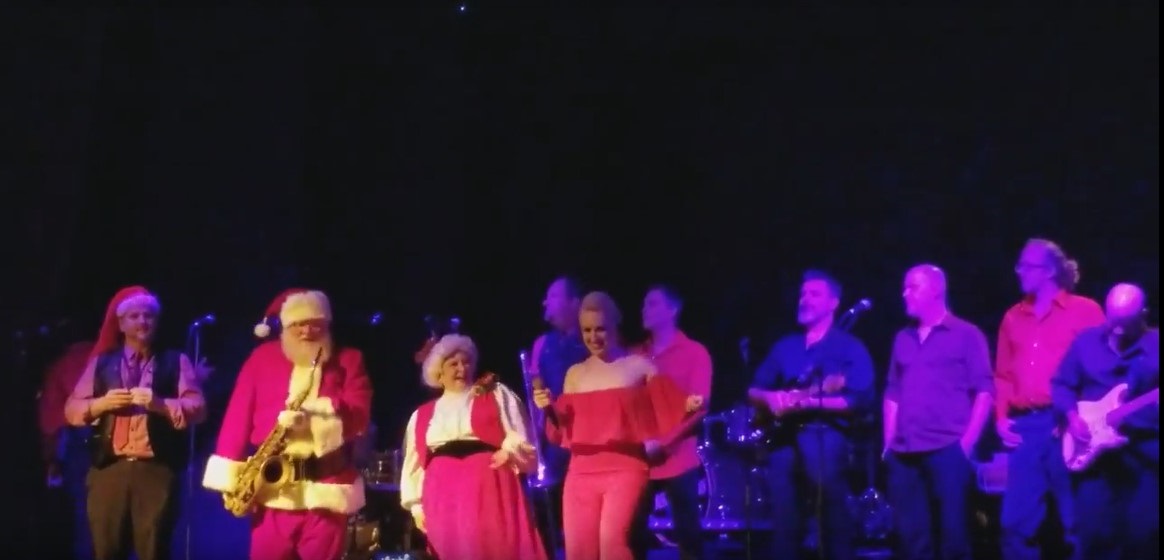
The inaugural Dashin' & Dancin' concert featuring The Refrigerators was a hit Saturday, December 2 at the Cohoes Music Hall. It was a great fundraising effort for the museum - and for those who were affected by the fire on Remsen Street just a few days before. One of the band members even donated his entire cut of the performance to those rebuilding! These guys are a great group of people and we had such a good time that we hope to be able to make this a yearly thing.

There were the usual fan favorites that they performed as well as some holiday songs!


There was a Christmas Conga Line and we had our own rendition of The Twelve Days of Christmas. Who do you think was the loudest group out of the twelve days of Christmas?


We even had Santa and his wife there to make sure we were nice...we were all nice this year, right?


Not even Santa could resist joining in on the fun with the band, showing off his moves with the saxophone!

Thank you to The Refrigerators for such a fantastic performance - they had us up and dancin' the night away!

It was a great way to support the museum and we wish everyone a happy holiday season 🎄🎄🎄🤶🎅📯🥁🎸🎙🎁🎁🎁

Friday, December 8, 2017

November 2017 Kickoff Lecture - Vampire Burials

Our kickoff lecture for this season's Winter Lecture Series was on November 14th at the Van Schaick Island Country Club. It's topic followed the Halloween mood with its focus on mortuary archaeology titled "Vampire Burials".

Presented by the museum's director, there was - of course - an issue with the microphone. Not sure what jinx I have regarding microphones, but this was the third talk I've given where I had to improvise. Our vice president picking it up at the end of the talk to poke around with it, only to have it work fine was just another clue that I may be jinxed...sigh....


But I want to thank everyone who came out to join us for the kickoff! You were great despite my technical difficulties.

Exploring some of the history and features of the vampire creature in various European cultures and mythologies, we focused on examples of deviant burials in the archaeological record that were strange enough to warrant the interpretation by the excavating archaeologists as having possibly belonged to individuals who were thought to be in danger of - or were already - these undead figures.


What is mortuary archaeology? As you can probably guess from the name, it's archaeology that focuses on the mortuary aspects of a culture, left behind in things like graves/tombs, funerary artifacts, and of course, the body itself. Studying how a society handled the treatment of their dead can tell you a lot about their culture.

But, as was stressed in the lecture, archaeology is an interpretation of findings. Yes, a lot of it has strong evidence to support it and forensic anthropology is a key feature in creating these interpretations of the past. But, then you have items where even the standard "it's ceremonial" is tossed out when archaeologists are left shrugging a bit.

There are a plethora of features associated with vampires and an accompanying variety of methods to deal with them. The majority of examples looked at in this lecture were from the early modern period (~1450 - 1690), but there are cases that suggest even ancient sites like the Iron Age example from Italy were on the lookout for potential vampires.

We looked at examples of these burials spanning from the British Isles, Scandinavian countries, eastern Europe, the Mediterranean, and into America in the mid-1800s during an outbreak of consumption (aka tuberculosis).


An example from Poland of a "vampire burial"
Scandinavian examples from folklore include creatures like this image -
       although the features and definition of this particular "vampire" changed
                                       over time to be more of a drowned vengeance-seeking creature preying on the living rather than the typical blood-drinking image most commonly associated with the figure of the vampire


We couldn't not explore anything from the place everyone thinks of when you hear the word
vampire. Romania is one of the few places where the vampire is so closely linked to what outsiders view of their culture that I had to look to see if there were any other potential cases of people having been treated for vampirism post-mortem. You can click on this link from the PBS series, Secrets of the Dead where they document a case from 2004.


And so, in some places, the vampire hunt continues!

Just keep this in mind in case you find yourself in a situation with such a creature:


Thursday, December 7, 2017

76th Anniversary of the Attack on Pearl Harbor


Today marks the anniversary of the event that acted as the trigger for the United States officially entering into World War II. The attack on the U.S. naval base on what was then still the U.S. territory of Hawaii by the Imperial Japanese spurred many into enlisting in the war.

You can learn more at this site
The attack lasted 110 minutes, from 7:55 a.m. until 9:45 a.m., as Japanese planes attacked on a Sunday in the belief that the Americans would be less alert on this day - many were still in their pajamas in the mess hall when the attack began. The United States aircraft carriers were the primary target of the attack, but the Japanese had their timing off and those carriers weren't at the base; due to this, the Japanese cancelled a second planned attack. Midget submarines were also used by the Japanese in this attack.

2,343 men were killed, 1,272 were wounded and 960 left missing.  A total of 2,335 U.S. servicemen were killed and 1,143 were wounded. 68 civilians were also killed and 35 were wounded. The Japanese also suffered casualties that day, although nowhere close in comparison: 65 men, with an additional soldier being captured - 28 Japanese planes were shot down and 5 midget submarines sunk.                                                                                                

Here's a video of the reporting that was put together last year for the 75th Anniversary that you can find on YouTube:


The next day, on December 8, 1941,  the country declared war on the Empire of Japan.  Shortly afterward, Nazi Germany, and its ally Italy, followed with a declaration of war against the United States for what it felt was a breach of neutrality agreements by the U.S. given the increasing cooperation by the U.S. with the United Kingdom through the countries' special relationship.  The United States responded with their own declaration of war on December 11, 1941.

As the famous Infamy speech by President Franklin D. Roosevelt conveys, this surprise attack left a lasting impression in the national psyche and contributed to the overwhelming sense of patriotism that was carried through the war by the country.

Here's an image of the WWII draft in Waterford, NY, taken July 22, 1942.


Members are listed on the back of the photo as:   Wally Rudebush, Jas A. Glavin,  Joe Hartnett,  Jack Harney, Molly Storm, Dr. Peckham, and Gordon Yaxley


Tuesday, November 14, 2017

The Waterford Historical Museum and Cultural Center was a guest today on the Schenectady Today Show with Ann Parillo! Check us out as we discussed our fantastic upcoming concert at the Cohoes Music Hall featuring The Refrigerators. Thank you to Ann for hosting us and to Dave Cerrone for joining us to talk about this fun event that will support the museum's mission and goals.

Jump to 12:38 to hear us!


We hope to see you all there at Dashin' & Dancin' on Saturday, December 2 from 7-10pm (doors open at 6pm). Tickets are $25 and can be pre-ordered and purchased at the door. Thank you for your support!

Monday, November 6, 2017

Hats And Helmets

The museum had a couple of displays in our parlor area that introduced you to what else could make its way along the Erie Canal, connecting to New York's observation of the centennial of state-level women's suffrage in 1917 as well as the United State's entry into World War I.

Here's a brief look at these exhibits in case you didn't get a chance to check them out over the summer:


While the right to vote at the national level wasn’t earned until 1920 with the passing of the 19th Amendment, there were state-level victories and New York women earned the vote at the state level three years before at the national level - November 6, 1917.

New York was home to the birth of the movement, with the Women’s Rights Convention held at Seneca Falls in 1848.


Part of the efforts to increase awareness of their efforts, suffragists took to wearing sashes and hats made special for their cause. This display ranges from the beginning of the Progressive Era with some examples of  smaller versions of 1890s hats, and end with an example from the 1920s when the flapper style was making its way to the forefront of women’s fashion. The Erie Canal was a significant ally for the suffrage campaign, as well as various other movements such as abolition and temperance.

For a musical number to help you learn some women's suffrage history, check out this video created by Soomo Publishing!

Also at the Museum, Acknowledging another Centennial


The U.S.A. entered into World War I in 1917, with Waterford sending several men to fight - ultimately three times more than required for the area - as well as nurses to aid our solders. Locals were also involved through projects like the war gardens, which came to be known as "victory gardens" and took root across the country to help deal with famines in Europe resulting from all the fighting and the lack of farmers. Many continued to maintain these gardens after the war's end, with a reemergence during WWII when commercial crops were again redirected to military overseas and transportation focused more on moving troops and munitions rather food.


The Erie and Champlain Canals - and later the Barge Canal System - operated in this capacity of transporting vital materials and boats from across the country. The Matton Shipyard was involved in these efforts, constructing large canal barges and deck barges for the U.S. Army during both World Wars.